Personal story by Ludovic Lin Yoshimura
I moved to Bangkok in early 2025 without knowing a single person. I had a laptop and a coworking membership. What I didn’t have was anyone to call on a Friday evening.
The usual playbook is well documented. Join a coworking space. Show up to meetups. Say yes to everything. I tried. I went to rooftop networking events where everyone asked the same three questions. I sat in cafes next to other people sitting in cafes. I joined Facebook groups where strangers organised bar crawls in Khao San. It helped a little. It didn’t solve anything.
Bangkok has thousands of expats, nomads, remote workers and travellers wandering through at any given moment. Access to people was never the issue. The issue was that none of these interactions transformed into anything permanent. You meet someone interesting at a Meetup event, exchange Instagram handles, and never speak again. The city puts you near people without giving you a reason to keep showing up for the same ones. That nomad loneliness is familiar: you are surrounded by people living the same life, and still leaving alone.
Football fixed that for me.
A WhatsApp group and twelve strangers
Pickup football simply means casual, drop-in games of football where anyone can show up and play without needing a fixed team or signing up for a league.
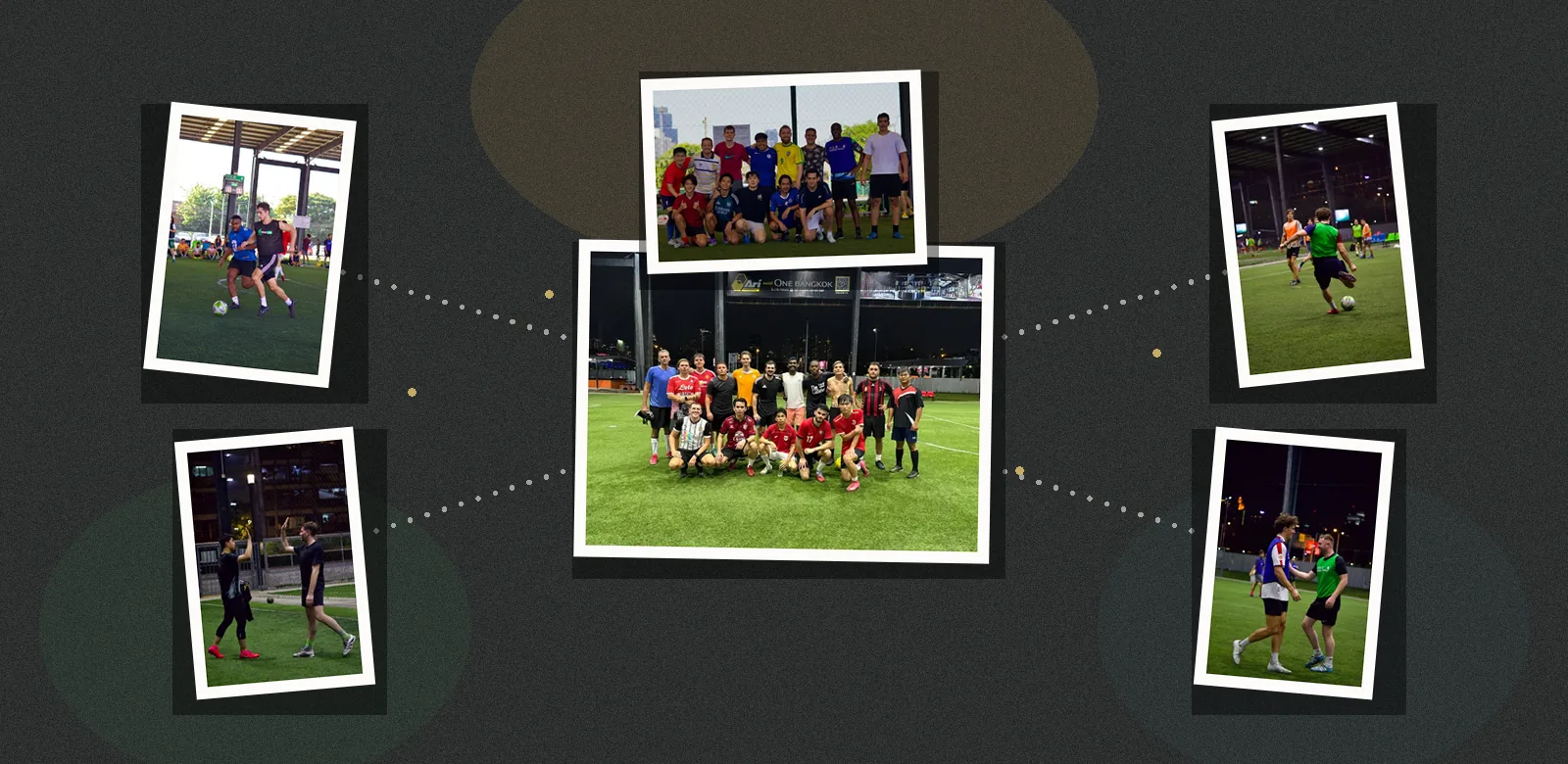
In October 2025, I posted in a WhatsApp group asking if anyone wanted to play football. Twelve people showed up to a pitch in central Bangkok. Some expats, some locals, nobody knew each other particularly well. We split into teams, played for an hour, and went home. People seemed happy enough. They said they would come back.
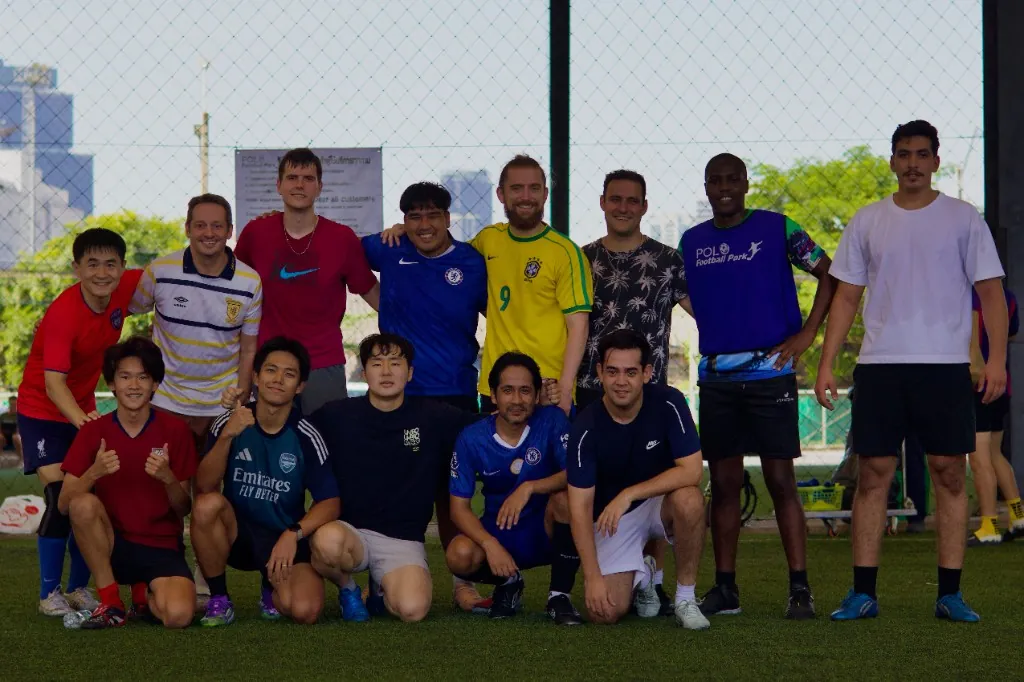
Most of them did. The next week there were fifteen. Then twenty. The games became regular, twice a week at the same venue, same time. Within a month, the WhatsApp group had its own vibe. People started recognising each other. They arrived early to warm up together. After the games, a few would walk to a nearby spot for food or drinks.
What started as a way to get exercise had become the centre of my social life in Bangkok. The friends I made through those games are the people I now call when something goes wrong or when I need to get out of my apartment.
Why football and not something else?
I have thought about this a lot. Why football? Why not running groups, yoga, any of the other social activities available in Bangkok?
Part of it is forced interaction. You cannot play a football game silently. You call for the ball, you coordinate positioning, you shout when someone makes a good run. The game makes you communicate whether you feel like it or not, which means you skip the part of socialising that most people find awkward. No small talk. No “so, what do you do?” on loop.
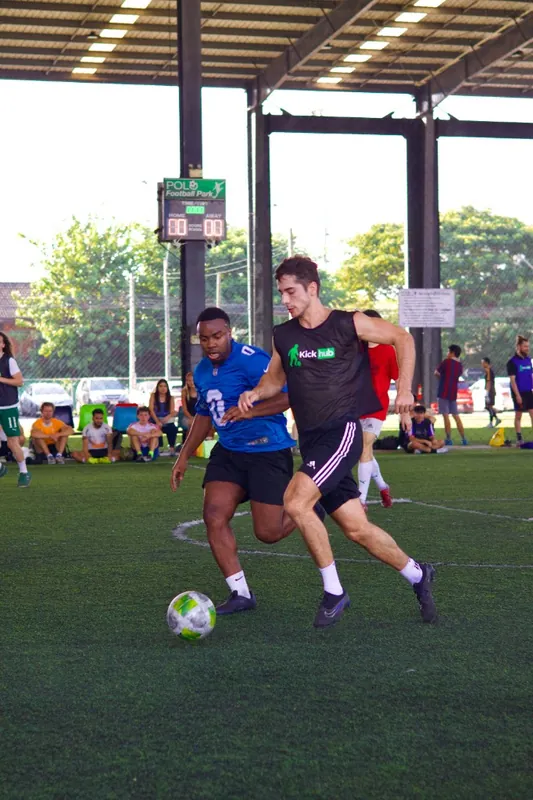
The bigger part is repetition. Show up to the same game twice a week and you start seeing the same faces. You learn names because you are yelling them across the pitch. You develop inside jokes about missed shots and questionable tackles. A guy you played against three weeks ago is suddenly someone you recognise at a cafe, and you stop to chat because you already have shared history. That is how friendships actually form, through accumulated contact over weeks, not one-off introductions.
A player named Thoï came to his first game completely alone. Thai local, quiet, visibly nervous. He wanted to meet people and improve his English but had no way in. At a bar or a networking event, he would have sat in a corner and left without talking to anyone. On the pitch, that was impossible. Someone needed him to mark a runner. Someone else passed him the ball and expected a decision. Within ten minutes he was talking. Within a few weeks he was one of the most social players in the group. He still comes at least three times a week.
I have watched that happen dozens of times. Someone walks onto the pitch looking uncertain and walks off sixty minutes later with three phone numbers and plans for the weekend.
What happens off the pitch
The part I didn’t expect was everything that happens off the pitch.
Players started doing business together. One guy runs an eCommerce brand and met a client at a game. Another player was launching a startup and found his first hire on the pitch. Nobody came to the games to network. But it happens naturally when you spend enough time with the same people. You learn what they do, and the trust is already there because you have been working as a team and sweating together for weeks.
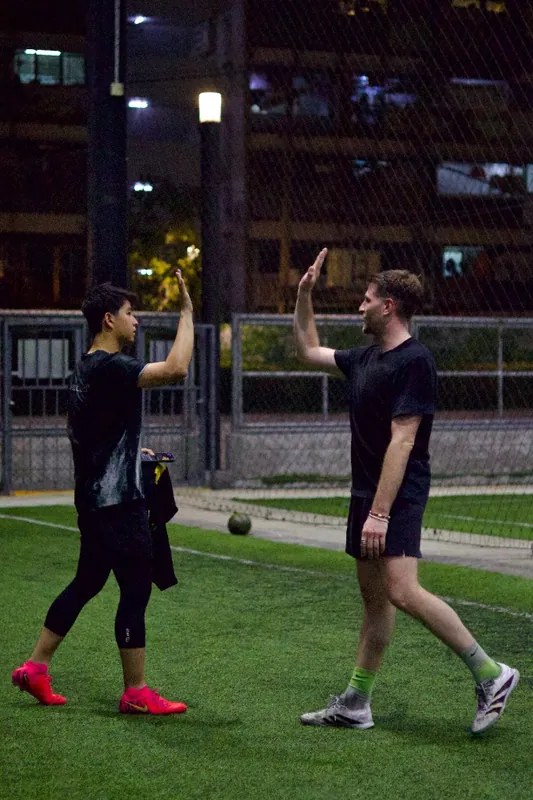
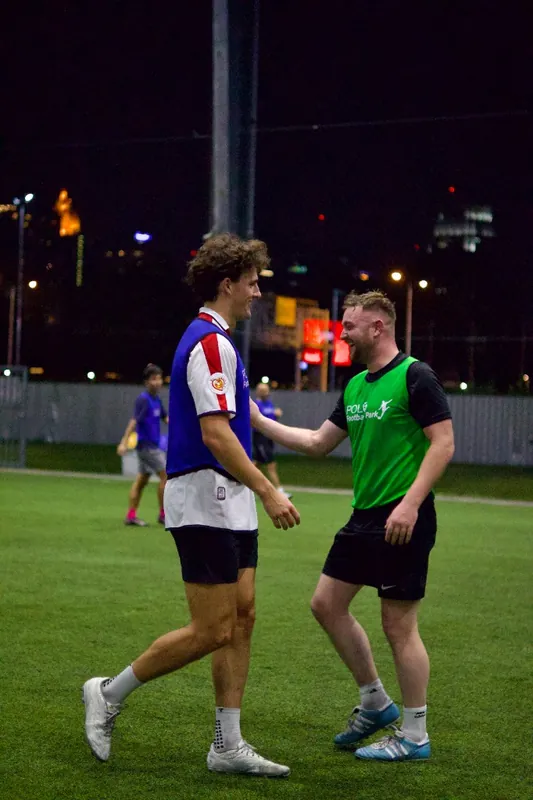
Sunday mornings at one of our regular venues turned into something like a ritual. After the game, a player who had just opened a bakery would bring pastries. People sat around in the shade, chatting about nothing in particular. A few minutes earlier we had been competing hard. Now we were eating tarts and making plans for the week.
Thursday evenings were completely different. More intense, more tactical. Players showed up with their crews and wanted to win. The atmosphere was closer to a proper league match than a casual kickaround. Some people preferred that energy. Both versions existed in the same community, and people gravitated toward whichever one suited them.
Bangkok-specific realities
Playing football here has its own quirks.
The heat is the obvious one. An English tourist showed up to a game in April, peak hot season, having just flown in from London. He lasted about three minutes before asking to sit out. No cardio, no acclimatisation, thirty-five degrees at eight in the evening. Most nomads who stay longer than a few weeks adjust. But that first session in Bangkok heat is humbling regardless of fitness level.
Then there is the rain. Monsoon runs roughly June to October, and it rains hard. You’d think that cancels everything. It does the opposite. Most players love it. A light rain cools the pitch and makes the game faster. People show up in bigger numbers during the rainy months than you’d expect. Games only get cancelled for actual storms, lightning overhead or the pitch completely flooded. Otherwise, you play.
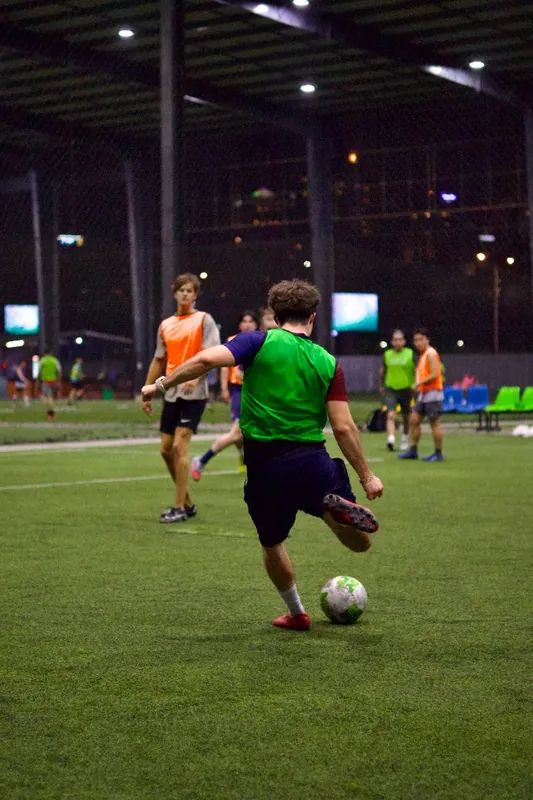
The diversity is harder to describe until you see it. In any given game you might have Brazilians, Japanese, French, Nigerian, Australian, and Thai players on the same pitch. Over a hundred nationalities have passed through since we started. A good pass does not require translation. That sounds cheesy written down, but on the pitch it is just true.
What other organisers get wrong
Before I started organising games, I played in a few of Bangkok’s existing pickup groups. Most are run through WhatsApp or Facebook, loosely organised, first-come-first-served.
In one group I joined, I showed up and spent most of the two-hour session sitting on the side. The regulars knew each other. They had their preferred teams, their preferred positions. New players filled the gaps and got whatever time was left. I played maybe thirty minutes out of two hours. Other people I spoke with had the same experience in different groups across the city.
That dynamic isn’t intentional. It’s just what happens when there is no structure. The people who have been there longest get priority by default. Someone showing up alone for the first time has no guarantee they will actually play.
That experience shaped how I thought about organising games. Everyone who books a spot plays the full session. Same price, same time on the pitch, whether it is your first game or your fiftieth. It sounds basic, but it matters. When someone knows they will actually get to play, they come back. And coming back is where the community part starts.
The compound effect
What surprised me most over the past year is how quickly things snowball.
A person comes once, alone. They came back the following week because they recognised a few faces. After a month they have a crew. After three months, those people are their friends in Bangkok. The group chat stops being about football. It becomes restaurant recommendations, weekend trips, apartment leads, visa advice.
I’ve seen people extend their stay in Bangkok because of the connections they made through these games. Nomads who planned to leave after a month decided to stay for six. Usually because of the people, more than the city itself. The hardest part of being a nomad isn’t the logistics. It’s finding people who feel like yours.
Football gave me that. The format is simple enough that it keeps working: show up, play, come back.
You don’t need to be good at football
If you’re reading this and thinking you’re not “good enough” to play, you’re probably wrong.
Nobody cares about your skill level. Some of the most well liked players in the community are average at the game itself but bring good energy or simply show up every week. All sessions are mixed and open to everyone regardless of gender or skill level. The people who get welcomed back are the ones who make it more fun for everyone else.
If you can run and kick a ball in the general direction of another person, you can play. It asks very little of you and gives back more than you’d expect.
Bangkok can feel very large and very anonymous when you first arrive. Having a recurring thing, a place where people expect to see you changes the whole experience. For me that thing happened to be football. It could be anything, really. But I haven’t found anything else that works this fast.
About the author
Ludovic Lin Yoshimura is the Co-Founder of KickHub, a pickup football platform connecting players across Bangkok and Bali. Originally from France, he moved to Bangkok in 2025 and started organising games through a WhatsApp group that quickly grew into a community of over 2,000 players from 100+ nationalities. When he is not on the pitch, he is figuring out how to bring the same experience to more cities across Southeast Asia. Find games in the KickHub app, follow them on Instagram, and read about their community in Bangkok.