
By Gongor Bandi
While guidebooks are helpful for historical context, they often struggle to capture the practical reality of travelling through the Mongolian interior. To move through this landscape is to move away from a world of predictable checkpoints and into a space where the environment dictates the terms of the journey.
For the traveler willing to leave the familiar behind, Mongolia offers more than wide-open steppes and rugged mountains – it offers a test of resourcefulness, patience, and adaptability. Each river crossing, each unmarked trail, and every encounter with nomadic communities reveals a side of travel that no map can fully convey.
This article invites you to step beyond the curated tourist experience and into a journey defined not by convenience but by discovery, challenge, and the raw beauty of one of the world’s most untamed landscapes.
Maps vs. The Territory
On a map, Mongolia appears as a country that can be crossed with measured time. However, once you leave the city’s paved infrastructure, those clean lines lose their authority. What looks like a short distance on paper often translates into hours of slow navigation across gravel, high grass, and riverbeds.
In the countryside and wild steppe of Mongolia, “roads” are rarely fixed or permanent. Instead, they are organic patterns of tire marks etched into the soil. These tracks frequently split into several directions, with none clearly marked as the primary route, and no signposts. Because weather can reshape a mountain pass or a valley floor overnight, a map is often just a starting point for a day-long negotiation with the terrain.
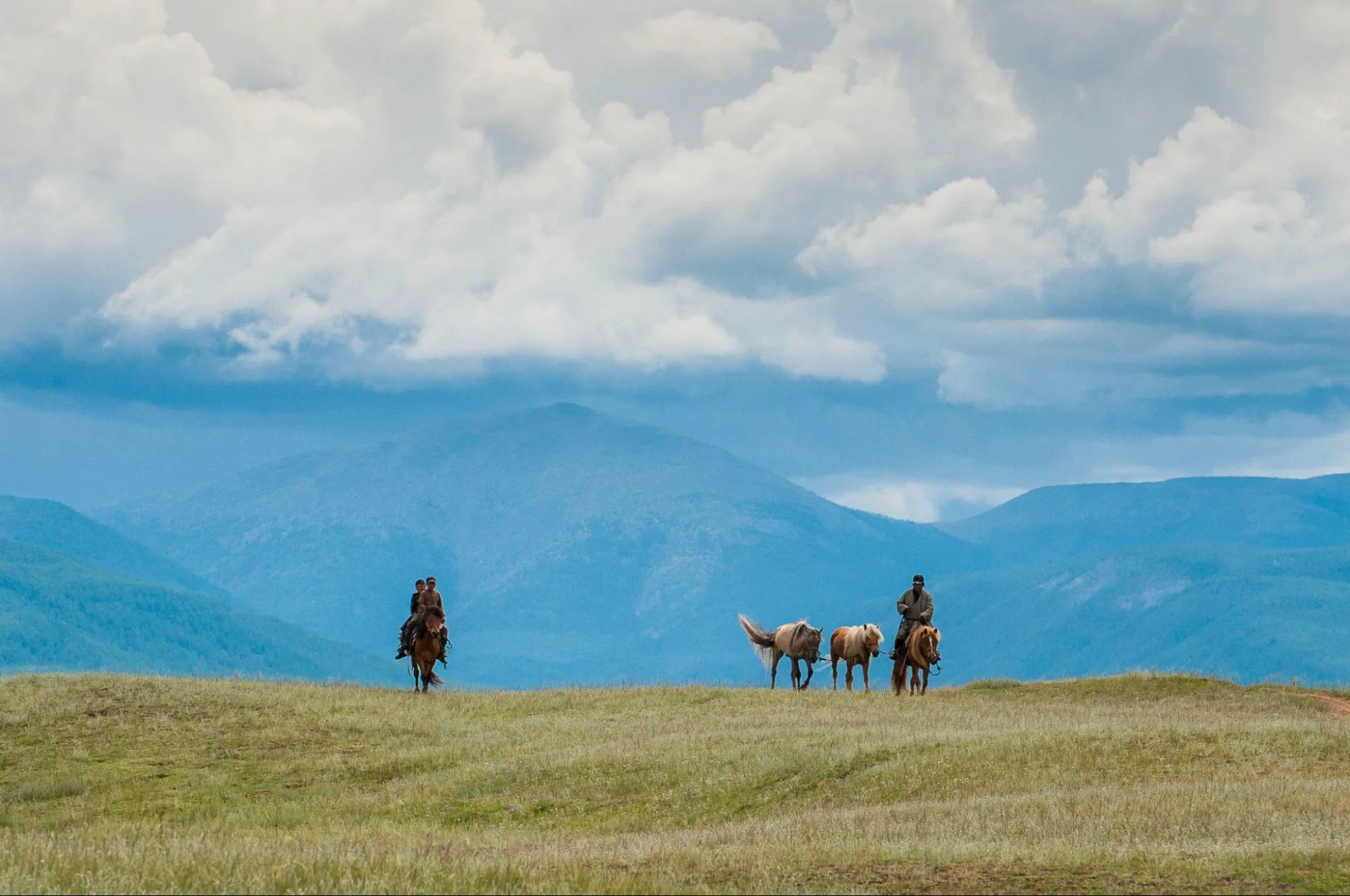
Standard travel guides depend on fixed landmarks, monastery ruins, or specific viewpoints. But the reality of the Mongolian landscape is found in the intervals between these stops. The value of the trip is usually found in the unplanned events: a sudden encounter with a moving herd, the shifting light across a range, or the total solitude of a track that hasn’t seen another vehicle in days.
Navigation as a Partnership
In an environment where digital maps are unreliable, certainty is replaced by human exchange. Navigation in the countryside is relational rather than technical. When you ask for directions, they rarely arrive as precise actions; instead, they are delivered as gestures toward distant ridges or valleys. A person may point in a direction that implies “keep going that way” rather than “at this exact coordinate.”
By asking for help, you enter a temporary partnership with someone else. Your path is shaped by a local’s real-time knowledge of wind, water, and the current state of the tracks. You begin to rely less on printed guidance or navigation systems, and more on human presence. The route becomes something that you inherit from the people who live along it at that moment.
This shift forces a change in how you handle a schedule. Instead of trying to control the movement, you learn to respond to the environment. Your plans must be flexible enough to bend around weather and animal migrations. You stop moving through the landscape as a visitor following a map and start moving through it with the adaptability of a real nomad.
Practical Field Notes
Reading the Braids
In the Mongolian interior, a road is rarely a single path. When the tracks split into five different directions, it is usually a response to the terrain; travelers detour to avoid recent snowmelt, deep mud, or washouts. Look for the freshest tracks. These are the paths locals currently use and are almost always the safest.
The Skyline
Digital maps are secondary to landmark orientation. An Ovoo, a shamanic rock cairn, typically marks the highest elevation in the area and serves as a navigational beacon where road signs are absent. It is a common local quirk: herders traveling on the highways often ignore exit numbers and route signs entirely, instead navigating with the same mountain-and-ridge orientation they use on the open steppe.
Navigational Etiquette
On the steppe, especially further away from main routes, asking for directions is a social encounter. It is common to be invited into a ger, where you will be offered tea or airag (fermented mare milk). In this environment, you engage with discussion about the place you left and the place you’re visiting. A simple request for a direction becomes a cultural connection.
Packing Essentials
Beyond your standard travel gear, it is practical to carry a supply of sweets or small treats. Most nomadic families have children. In remote regions far from any settlement, these items are big treats. While nomadic hospitality doesn’t ask for anything in return for refreshments and directions, offering treats for the children is greatly appreciated, and watching their eyes light up is priceless.
The Logic of Open Space
To move effectively through Mongolia, you have to understand that you are traveling through inhabited land, even when it appears empty. Nomadic life is defined by continuity. Families move with the seasons, and their relationship with the land is one of belonging rather than possession.
Staying in a ger can give you a direct look at this logic and lifestyle. A ger is not anchored to the earth with permanent foundations, yet it is a highly sophisticated piece of engineering designed for mobility. Hospitality here is not a formal service industry; it is a natural extension of living in a wide space. You aren’t visiting a tourist site; you are being folded into a daily rhythm where tea is poured and food is shared because that is what the environment demands of its inhabitants - to welcome and help others that they meet.
This nomadic perspective teaches us that movement is a constant part of living. The valleys you cross are the same ones used by children walking to school or herds moving to better pastures. Paths exist because they have been walked or criss-crossed for generations, not because they were designed for visitors. In Mongolia, the landscape writes its own rules, and the best stories come from the roads you can’t see on a map.
About the author
With over 25 years of experience navigating through Mongolia, Gongor Bandi has been establishing remote routes with sustainable logistics. As the founder of Gobi Travel, he specializes in matching the “unmapped” reality with refined attention.